

Property Market
Sydney Versus Brisbane: Where Does Your Income Buy You More Property in 2026?
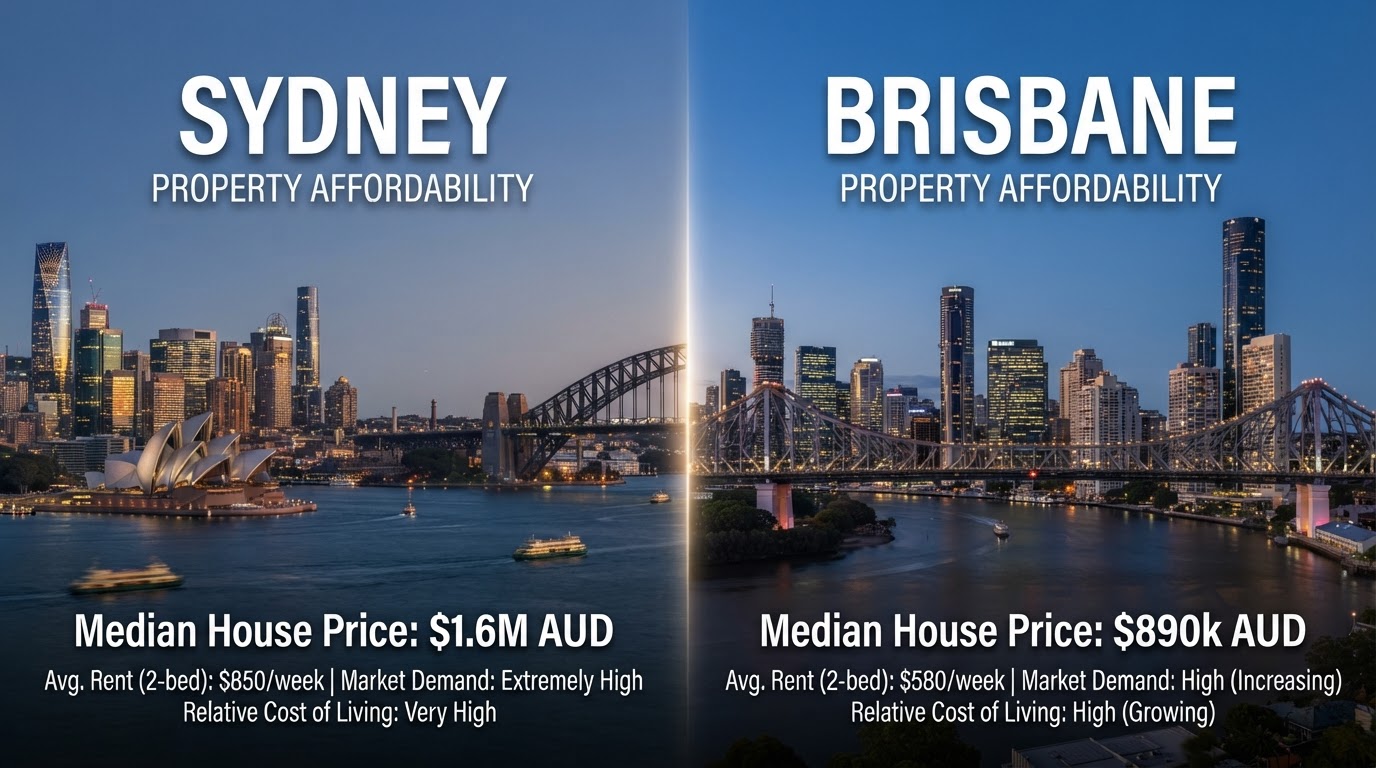
Key takeaways
- Falling values: national home values fell 1.2% in October 2026, a seventh consecutive monthly fall.
- City moves in October: Brisbane down 2.0%, Sydney down 1.6%.
- Capitals combined: down 8.1% over seven months.
- Cash rate: 4.85% after the RBA's 3 November 2026 rise.
- Same lending rules: loans assessed at least 3 points above the loan rate in both cities.
- Repayment gap: about $2,528 a month between a $1.2 million and an $800,000 loan at 6.5%.
Brisbane still offers lower entry prices than Sydney, but the gap in what your income can buy depends on more than price. Both markets are falling: Cotality's November 2026 Home Value Index shows national values down 1.2% in October, the seventh straight monthly decline, with Brisbane down 2.0% and Sydney down 1.6%. Meanwhile the Reserve Bank lifted the cash rate to 4.85% on 3 November, and lenders still assess loans at least 3 percentage points above the loan rate. Your borrowing capacity is based on income, expenses and debts, not the city, so the same household can borrow the same amount in either place. What changes is what that budget buys and what the repayments are. On illustrative figures, a $1.2 million Sydney loan costs about $2,528 a month more than an $800,000 Brisbane loan at 6.5%, more than $30,000 a year.
It is not simply about what a property costs. It is about how much you can borrow, what you need upfront and whether you can comfortably repay it.
Sydney and Brisbane purchases compared
| Purchase details | Sydney | Brisbane | Difference |
|---|---|---|---|
| Property price | $1,500,000 | $1,000,000 | $500,000 |
| Deposit at 20% | $300,000 | $200,000 | $100,000 |
| Mortgage required | $1,200,000 | $800,000 | $400,000 |
| Monthly repayments at 6.5% | $7,585 | $5,057 | $2,528 |
| Annual repayments | $91,020 | $60,680 | About $30,340 |
Illustrative only: hypothetical prices, not median values or advertised rates. 30 year principal and interest loans at 6.5%, rounded. Excludes stamp duty and other purchase costs.
How are Sydney and Brisbane property prices tracking in 2026?
Both are falling, with Brisbane falling faster. Cotality's Home Value Index shows national dwelling values fell 1.2% in October 2026, the seventh consecutive monthly decline, leaving the national index 6.7% below its March peak. Brisbane values fell 2.0% in October and 6.1% over the rolling quarter, while Sydney fell 1.6% in the month and 4.7% over the quarter. Combined capital city values are down 8.1% over seven months.
Even so, Sydney remains a much more expensive market overall, particularly in the Eastern Suburbs, Lower North Shore and Inner West. Brisbane generally offers lower entry prices across the broader market, although sought after inner city suburbs still command a premium.
What can a household earning $200,000 afford?
The same loan in either city. Take a household with a combined $200,000 income, a 20% deposit, no dependants and no significant debts. Its borrowing capacity depends on lender policy, living expenses, employment and other commitments. Assume it is approved for an $800,000 loan, which with a 20% deposit supports a purchase of about $1 million before stamp duty and costs.
That capacity does not rise because the home is in Brisbane rather than Sydney. What changes is what it buys. In Sydney, $1 million may point buyers towards apartments, smaller homes or suburbs further from the CBD. In Brisbane, the same budget may open up a wider range of property types in some suburbs, although location and quality still matter.
How much difference does the purchase price make?
A lot, once you look at repayments. On a hypothetical $1.5 million Sydney purchase and a $1 million Brisbane purchase, each with a 20% deposit, the Sydney buyer needs a $1.2 million loan and the Brisbane buyer $800,000. At 6.5% over 30 years, monthly repayments are about $7,585 and $5,057, a gap of about $2,528 a month or more than $30,000 a year. For households weighing a move between the two cities, that difference shapes disposable income, savings and lifestyle.
How do stamp duty and upfront costs compare?
They can differ significantly. Stamp duty, legal fees, inspections and other purchase costs come on top of the deposit. New South Wales and Queensland use different transfer duty schedules, and both offer concessions to some eligible buyers, including first home buyers. A buyer of an established home in Sydney can face very different upfront costs from someone buying a similarly priced home in Brisbane, so calculate them early with each state's revenue office rather than treating them as an afterthought.
Why does borrowing capacity matter more than ever?
Because the lending test is tougher than the repayments. APRA requires lenders to assess loans at a rate at least 3 percentage points above the loan rate, and kept that buffer unchanged in May 2026. A loan offered at 6.5% is therefore generally assessed at 9.5% or more. With the cash rate now at 4.85%, a household can feel comfortable with the advertised repayments and still not qualify for the amount it wants. That bites hardest for Sydney buyers needing larger loans, but the same principles apply in Brisbane.
Is Brisbane automatically the better financial choice?
Not necessarily. A lower purchase price helps, but affordability is about more than price. Work through these questions before deciding:
1. Get your borrowing capacity assessed. Know what lenders will approve before you compare suburbs in either city.
2. Compare total repayments. Model repayments at today's rates, and at higher rates, for each likely purchase price.
3. Calculate upfront costs. Work out stamp duty, concessions and purchase costs under each state's rules.
4. Weigh living costs and income. Consider jobs, salaries, commuting, insurance and maintenance in each city.
5. Think long term. Check the property suits your future housing needs, not just today's budget.
A cheaper property is not automatically a better investment, and a dearer Sydney property is not necessarily unsuitable if you have the income, equity and cash reserves. What matters is whether the property and the loan fit your wider finances.
Buying in Sydney or Brisbane?
The real question is not which city is cheaper, but where your income, deposit and borrowing capacity can support the right property without unnecessary pressure. With teams in Sydney and Brisbane, Olive Road Financial helps first home buyers, upgraders, interstate movers and investors understand their borrowing capacity and compare lenders, which may assess income, debts and expenses differently. Contact Olive Road Financial to discuss your options in either city.
Olive Road Financial's view
With teams in both cities, we often help buyers compare Sydney and Brisbane side by side. The answer is rarely just about price. Your borrowing capacity travels with you, but repayments, stamp duty, living costs and your income prospects do not. Getting a clear assessment first lets you compare the two markets on real numbers, not headlines.
It is not simply about what a property costs. It is about how much you can borrow, what you need upfront and whether you can comfortably repay it.
About Olive Road Financial
Olive Road Financial is a mortgage broking business with teams in Sydney and Brisbane, helping clients with home, investment and commercial lending. We compare lenders, explain how each one assesses borrowing capacity and look after the application from preapproval to settlement. Thinking of buying, refinancing or investing? Book an appointment with the Olive Road Financial team.
Frequently asked questions
Sources
- Cotality (2 November 2026). "Housing downturn broadens as Brisbane and Perth lead the decline." Home Value Index, November 2026.
- Reserve Bank of Australia (3 November 2026). "Statement by the Monetary Policy Board: Monetary Policy Decision." Media release 2026-30.
- Australian Prudential Regulation Authority (28 May 2026). "APRA maintains current macroprudential policy settings in highly uncertain environment."
If you're considering refinancing, buying a home or reviewing your investment lending, Olive Road Financial can help you understand your lending options and determine what may be suitable for your circumstances.
Get in touch with our team